
Liquidity pools, directly inspired by decentralized finance (DeFi), are revolutionizing the landscape of online sports betting. Unlike traditional bookmakers who control odds and margins for profit, liquidity pools introduce a system built on transparency, efficiency, and shared value. At BettingRanker, we delve into how this user-centric approach is transforming Pakistan's betting industry and offering players a more equitable experience.
Exploring Liquidity Pools in Sports Betting
In sports betting, a liquidity pool acts as a collective wallet, funded by numerous users to support various wagering markets. Instead of a sportsbook serving as the counterparty for every bet, the pool holds the funds to cover potential payouts. Users have the dual role of bettors and liquidity providers (LPs), contributing capital back into the system. Smart contracts automatically manage sports betting odds, settle bets, and enforce the rules, significantly reducing the need for human intervention and potential bias.
This concept is adapted from DeFi, where liquidity pools fundamentally changed token trading by ensuring constant liquidity without relying on traditional order books. In betting, the advantages are similar: real-time odds adjustments, automated settlements, and fully auditable transactions. As more participants contribute to a pool, market volatility decreases, leading to more stable odds that benefit both bettors and liquidity providers.
Because the pool operates under transparent code rather than opaque policies, trust is inherently built into the system. By design, bettors can be confident that once they meet the smart contract's conditions, payouts will be automatic and fair.
A Look at Liquidity Pools vs. Traditional Sportsbooks
Traditional sportsbooks operate on centralized odds-setting and internal risk management. Bookmakers bear all liabilities and incorporate a house edge to guarantee profits. This model often involves manual odds adjustments based on betting patterns when betting on sports outcomes, which can introduce human bias and lead to slower reactions.
In contrast, platforms utilizing liquidity pools function via smart contracts that execute automatically based on live data feeds. These platforms distribute risk among liquidity providers, replacing the traditional house edge with service fees. Automation not only slashes operational costs but also enhances fairness and removes the inherent conflicts of interest where an operator profits from user losses.
Traditional Sportsbooks vs. Liquidity Pool Platforms in Pakistan
| Feature | Traditional Sportsbooks | Liquidity Pool Platforms |
|---|---|---|
| Odds Control | Centralized (by bookmaker) | Decentralized (via smart contracts) |
| Profit Model | House edge & user losses | Transaction fees |
| Risk Management | Internal hedging | Shared across liquidity providers |
| Transparency | Limited | Full (on-chain visibility) |
| User Role | Bettor only | Bettor + Liquidity Provider |
| Payout Settlement | Manual or delayed | Instant via smart contracts |
Why Pakistani Bettors Are Embracing Liquidity Pools?
- Better Returns & Fairer Odds: With no inherent house edge and significantly lower operational costs, liquidity pool models typically offer more favourable returns to bettors. In some systems, payout improvements of 20–30% over traditional platforms are achievable. Since profits are generated from fee structures rather than from managing losing bets, the incentive alignment is fundamentally different.
- Transparency & Verifiability: Every transaction, from bet placement to odds changes and settlements, is recorded on the blockchain. This allows bettors to confirm that the system operates according to its rules. There are no hidden adjustments, delayed settlements, or operator interference behind the scenes. The inherent auditability of blockchain technology significantly boosts trust for Pakistani users.
- Participation as Stakeholders: Liquidity pool models effectively blur the lines between bettor and investor. Users can contribute capital to the pool and earn fees, thereby gaining a vested interest in the platform's performance. This dual-role model encourages deeper user engagement and aligns individual interests with the overall success of the platform.
- Lower Counterparty Risk: In centralized betting environments, players depend entirely on the solvency and integrity of the sportsbook. However, in a decentralized pool, funds are secured within smart contracts under collective control. This shift substantially mitigates the risks of fraud, insolvency, or manipulation by a single central operator for all users abroad.
Benefits for Operators and Platform Stability
Liquidity pool systems also benefit operators by redistributing risk and improving capital efficiency. Rather than absorbing every bet’s liability, platforms share exposure with liquidity providers. Here are some advantages for operators:
- Shared Risk & Capital Efficiency: Instead of absorbing full liability, operators offload risk to liquidity providers, optimizing how capital is allocated.
- Scalable Growth: As pools grow, the system naturally acquires liquidity without requiring proportional capital injections from the operator.
- New Market Expansion: Deep liquidity supports launching new bet types, longer odds markets, and more exotic wagers with less incremental risk exposure.
- Regulatory and Audit Clarity: Because smart contracts are transparent and traceable, operators can more easily demonstrate compliance, fairness, and anti‑fraud mechanisms to regulators.
Together, these elements allow platforms to expand faster, leaner, and with better systemic robustness.
Technological Innovation and Industry Evolution in Spots Betting
Smart Contracts, Oracles & AMMs
Smart contracts form the backbone of a liquidity pool system, but they require precise event data to function properly. Oracles feed real-world sporting outcomes, statistics, and timings into the blockchain to trigger payouts, validate online payment methods' conditions, and adjust odds. In some DeFi‑betting hybrids, oracles are decentralized or multi-sourced to avoid single points of failure or manipulation.
On the pricing side, liquidity pools often rely on automated market maker (AMM) logic or constant-function market maker (CFMM) models, adapting formulas such as x×y=kx \times y = kx×y=k to define how odds shift relative to pool composition. In sports betting, modified AMM logic (for instance, UBET’s UAMM) has been proposed to better align odds with bookmakers’ models.
AI & Machine Learning Optimization
Artificial intelligence and machine learning overlay new intelligence on top of immutable contract logic. These systems can:
- Anticipate betting flows and adjust liquidity parameters dynamically.
- Predict mismatches or imbalances in pool segments and reallocate capital.
- Detect suspicious betting patterns or arbitrage exploits.
- Aid in managing impermanent loss risk by adjusting fee curves adaptively.
By integrating AI/ML, platforms can enhance odds accuracy and system resilience.
Hybrid Models & Industry Adoption
Some established sportsbooks are exploring hybrid structures—combining centralized control and liquidity pool features. These hybrids might retain traditional odds control while opening select markets to decentralized liquidity. This approach provides familiarity to users and operational safety for legacy platforms.
Indeed, several pioneering operators are already piloting full liquidity pool platforms, showing that the concept is more than theoretical—it’s actively being tested in live environments.

Real-World Examples and Regulatory Landscape in Sports Betting
Major Providers with Liquidity Pool or P2P Potential
Several companies are leading or supporting the shift toward decentralized or pool-based betting:
- Playtech – A major sportsbook and iGaming software vendor with the capability to support liquidity pool architecture.
- Evolution – Known for live casino offerings, Evolution’s platform reach makes it a strong candidate for P2P integration, though it lacks current pool-specific features.
- OpenBet – Supplies high-volume sportsbook systems with architecture that supports multi-market liquidity aggregation.
- Longitude LLC – Specializes in pari-mutuel betting and has pioneered shared liquidity pool mechanics in large-scale betting markets.
Different Risk Models in Use
The way platforms manage and distribute risk varies depending on the architecture:
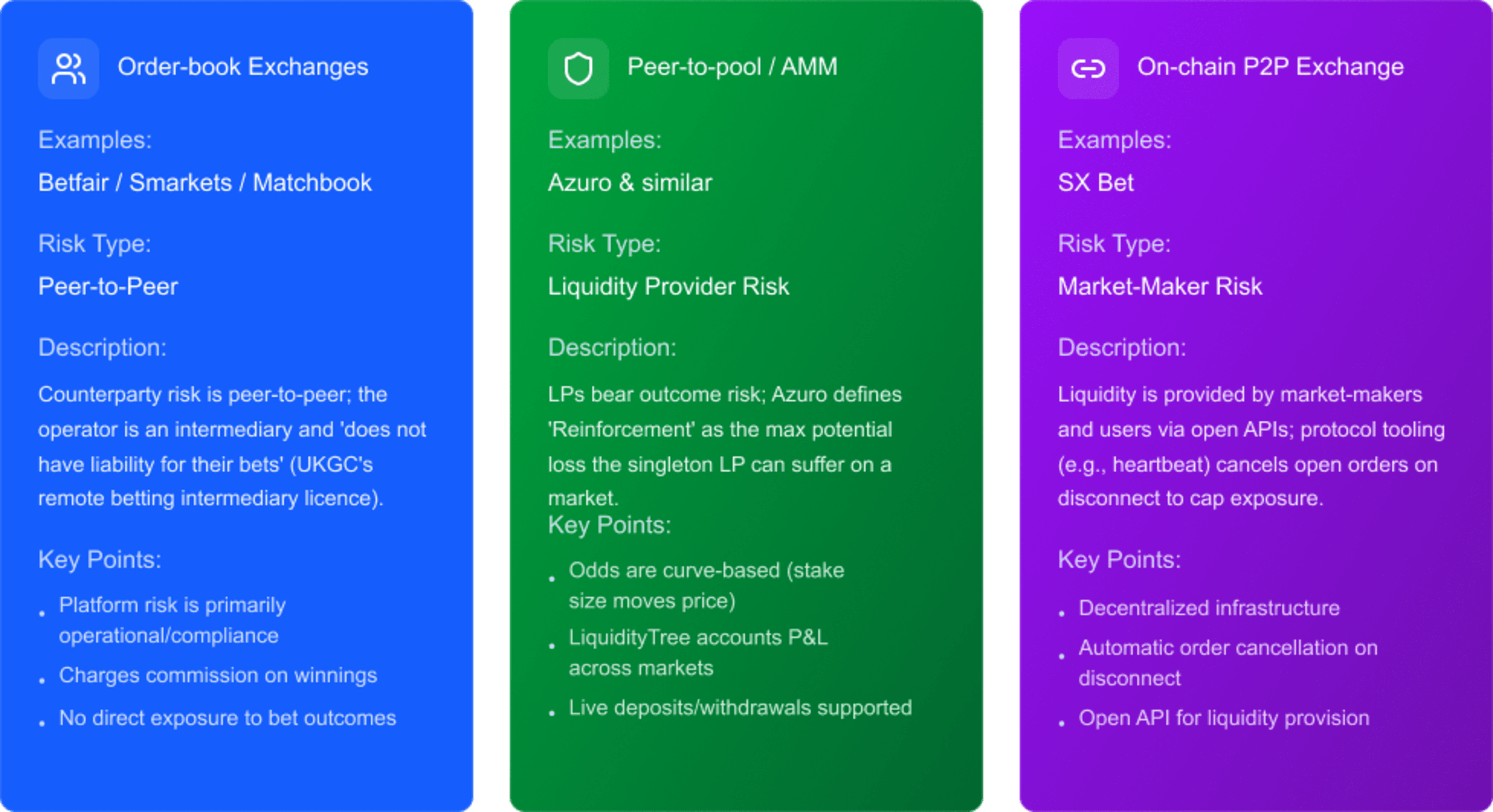
- Order-book Exchanges (e.g., Betfair, Smarkets, Matchbook): Counterparty risk is peer-to-peer. The platform acts as an intermediary without taking liability for user bets. Its income is derived from commissions.
- Peer-to-Pool / AMM (e.g., Azuro): LPs bear the risk of outcomes. For instance, Azuro introduces a "Reinforcement" metric to cap the maximum loss an LP can face. Odds shift based on stake size using an algorithmic curve model.
- On-Chain P2P Exchanges (e.g., SX Bet): Liquidity is sourced from both users and market makers through APIs. Systems like "heartbeat" ensure exposure is capped by canceling open orders when users disconnect.
Where Exchange and P2P Betting Is Permitted
Betting regulation varies globally. The following jurisdictions allow exchange or peer-to-peer betting:
| Country | Regulatory Notes |
|---|---|
| United Kingdom | Licensed under the UKGC as remote betting intermediaries; exchanges like Betfair operate legally. |
| Ireland | Requires a Remote Betting Intermediary Licence; subject to Betting Intermediary Duty. |
| Spain | National legislation includes “Apuestas deportivas cruzadas” (exchange sports betting). |
| Australia | The Northern Territory licenses betting exchanges; Betfair Pty Ltd holds this license. |
| United States | Authorized in some states (e.g., New Jersey) for horse racing and sports wagering under state-specific rules. |
These regions provide blueprints for how decentralized or hybrid models can operate legally and competitively. The trend toward expanding these frameworks is likely as technology and user demand evolve.
Risk Managements Frameworks:
Key Benefits of Liquidity Pools in Sports Betting
Here’s a summary of the standout benefits for bettors and top sports betting platforms:
- For Bettors: Higher potential returns, better odds, and full transparency through blockchain verification.
- For Platforms: Risk decentralization, cost reduction, and simplified compliance with regulatory standards.
Conclusion: The Future Is Transparent and Decentralized
Liquidity pools aren’t just disrupting sports betting—they’re redefining it. By removing centralized control, reducing systemic risk, and empowering users through dual participation, they represent a sustainable and scalable model for the future. Top platforms already adopting this model are demonstrating that decentralized betting is not only viable but highly competitive.
As users demand more transparency, fairness, and financial upside, liquidity pools stand out as the logical evolution. Those who embrace this change early—whether operators or bettors—will be best positioned to benefit in the next era of online betting.
FAQ
What is a liquidity pool in sports betting?
A liquidity pool is a shared fund where users deposit money to support sports betting markets. It uses smart contracts instead of a traditional bookmaker to automatically manage odds, payouts, and bet settlements.
How does liquidity pool betting differ from traditional sportsbooks in Pakistan?
Unlike traditional sportsbooks that control odds and profits, liquidity pools use algorithms driven by market activity. Users can directly participate by placing bets or providing liquidity, which promotes transparency and fairness.
Are liquidity pools legal for online betting in Pakistan?
The legality of liquidity pools depends on Pakistan's gambling regulations. Their transparent, blockchain-based nature can make it easier to demonstrate regulatory compliance. Always check local laws before participating.
Do liquidity pools offer better odds than sportsbooks?
Yes, liquidity pools often provide better odds, potentially 20–30% higher, due to lower operational costs and no house edge. Odds are adjusted in real-time based on betting activity.
Can users earn money by providing liquidity?
Yes. Users who contribute to the pool earn a share of transaction fees and may also profit from successful bets. This offers a dual-income opportunity not found in traditional betting.
How do smart contracts manage sports bets?
Smart contracts automatically adjust odds, accept wagers, settle bets, and distribute winnings. This reduces human error and ensures faster, more reliable outcomes for bettors in Pakistan.
Is liquidity pool betting secure?
Liquidity pool platforms use blockchain technology and smart contracts, which lower counterparty risk and increase transaction transparency. Funds are managed autonomously, not by a central authority.
What are the benefits of liquidity pools for betting operators?
Operators benefit from distributed risk, automated operations, and lower overhead. As the pool grows, market stability improves without increasing liability.
Will sportsbooks adopt liquidity pool models?
Yes, hybrid models are emerging as sportsbooks explore decentralized features. Integrating liquidity elements helps them remain competitive and user-focused in the evolving online betting landscape.